

Shockwave Therapy
What is Shockwave Therapy?
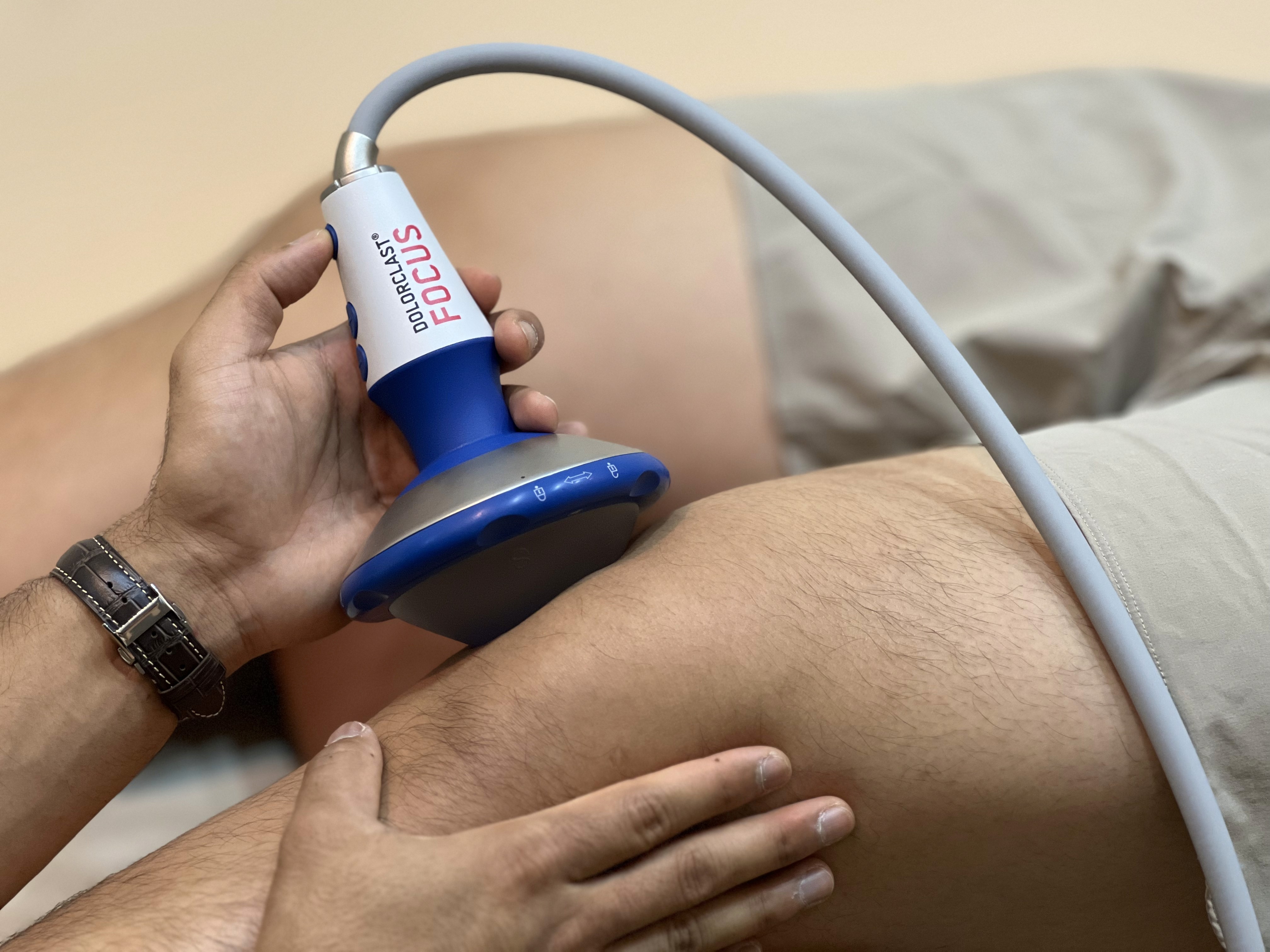
Shockwave Therapy, also known as Extracorporeal Shockwave Therapy (ESWT), is a non-invasive treatment that uses acoustic waves to promote healing and pain relief in various musculoskeletal conditions. It involves delivering high-energy sound waves to affected tissues through a handheld device. It is commonly used for chronic pain conditions that have not responded to other conservative treatments, particularly those involving tendons, ligaments, and bones.
How does it work?
Shockwave Therapy works by generating rapid pressure changes (the "shockwaves") that propagate into the target tissue. When these waves interact with the body's tissues, they induce a range of biological effects. Research suggests these effects include stimulating neovascularization (formation of new blood vessels), which improves blood supply and oxygen to the treated area, promoting tissue regeneration and repair, breaking down calcifications in tendons, and stimulating cells responsible for bone and connective tissue healing. Shockwave Therapy also has a direct effect on pain receptors, contributing to immediate pain reduction.
What to expect
The sensation during Shockwave Therapy can vary from patient to patient and depends on the energy level used and the area being treated. It is often described as a series of rapid, strong pulses or a "thumping" sensation. While it can be uncomfortable or even slightly painful during the actual application, this discomfort is temporary and generally well-tolerated. The pain typically subsides immediately after the treatment stops. Your therapist will adjust the intensity to ensure it is effective while remaining tolerable.
How long will the treatment take?
A typical Shockwave Therapy session is quite brief, usually lasting between 5 to 20 minutes, depending on the size and nature of the treated area. The speed and efficiency of the treatment make it a convenient option for many patients.
General frequency
The general frequency for Shockwave Therapy typically involves 3 to 6 sessions, usually administered once a week or every other week. However, the exact number and frequency of sessions will vary depending on the severity and chronicity of your condition, as well as your individual response to the therapy. Your personalized treatment plan will be determined during your initial consultation.
Is it safe or effective?
Shockwave Therapy is generally considered safe and effective for many musculoskeletal conditions. It is a non-invasive procedure, minimizing risks associated with surgery. The FDA has cleared ESWT devices for specific indications such as plantar fasciitis and tennis elbow, affirming its safety and effectiveness for these conditions. Numerous clinical studies support its efficacy, particularly for chronic tendinopathies, calcific shoulder tendinitis, and plantar fasciitis, demonstrating significant pain reduction and functional improvement in a high percentage of patients.
Are there any risks or side effects?
When performed by a qualified practitioner, Shockwave Therapy has a low risk of serious side effects. Potential, usually minor and temporary, side effects may include:
• Mild swelling, redness, or bruising in the treated area.
• Temporary increase in pain or tenderness immediately after the session.
• Numbness or tingling.
Shockwave Therapy is generally not recommended for certain individuals, including pregnant women, individuals with blood clotting disorders or taking anticoagulant medications, those with active infections or tumors in the treatment area, or in areas directly over nerves, major blood vessels, or growth plates in children. We will conduct a thorough physical examination to determine if this therapy is appropriate for you.
How do I know I need it?
You might benefit from Shockwave Therapy if you are experiencing chronic pain related to specific musculoskeletal conditions that haven't responded well to other conservative treatments like rest, ice, medication, or physical therapy. Common conditions for which Shockwave Therapy is often recommended include:
• Plantar fasciitis (heel pain)
• Achilles tendinopathy (Achilles tendon pain)
• Tennis elbow (lateral epicondylitis) and Golfer's elbow (medial epicondylitis)
• Rotator cuff tendinitis (shoulder pain), especially with calcifications
• Patellar tendinopathy (jumper's knee)
• Shin splints
• Non-union fractures (bones that haven't healed properly)
If you're suffering from persistent musculoskeletal pain, a consultation with our experienced team can help determine if Shockwave Therapy is the appropriate and effective solution to help you find lasting relief and get back to living pain-free.
What is Shockwave Therapy?
Shockwave Therapy, also known as Extracorporeal Shockwave Therapy (ESWT), is a non-invasive treatment that uses acoustic waves to promote healing and pain relief in various musculoskeletal conditions. It involves delivering high-energy sound waves to affected tissues through a handheld device. It is commonly used for chronic pain conditions that have not responded to other conservative treatments, particularly those involving tendons, ligaments, and bones.
How does it work?
Shockwave Therapy works by generating rapid pressure changes (the "shockwaves") that propagate into the target tissue. When these waves interact with the body's tissues, they induce a range of biological effects. Research suggests these effects include stimulating neovascularization (formation of new blood vessels), which improves blood supply and oxygen to the treated area, promoting tissue regeneration and repair, breaking down calcifications in tendons, and stimulating cells responsible for bone and connective tissue healing. Shockwave Therapy also has a direct effect on pain receptors, contributing to immediate pain reduction.
What to expect
The sensation during Shockwave Therapy can vary from patient to patient and depends on the energy level used and the area being treated. It is often described as a series of rapid, strong pulses or a "thumping" sensation. While it can be uncomfortable or even slightly painful during the actual application, this discomfort is temporary and generally well-tolerated. The pain typically subsides immediately after the treatment stops. Your therapist will adjust the intensity to ensure it is effective while remaining tolerable.
How long will the treatment take?
A typical Shockwave Therapy session is quite brief, usually lasting between 5 to 20 minutes, depending on the size and nature of the treated area. The speed and efficiency of the treatment make it a convenient option for many patients.
General frequency
The general frequency for Shockwave Therapy typically involves 3 to 6 sessions, usually administered once a week or every other week. However, the exact number and frequency of sessions will vary depending on the severity and chronicity of your condition, as well as your individual response to the therapy. Your personalized treatment plan will be determined during your initial consultation.
Is it safe or effective?
Shockwave Therapy is generally considered safe and effective for many musculoskeletal conditions. It is a non-invasive procedure, minimizing risks associated with surgery. The FDA has cleared ESWT devices for specific indications such as plantar fasciitis and tennis elbow, affirming its safety and effectiveness for these conditions. Numerous clinical studies support its efficacy, particularly for chronic tendinopathies, calcific shoulder tendinitis, and plantar fasciitis, demonstrating significant pain reduction and functional improvement in a high percentage of patients.
Are there any risks or side effects?
When performed by a qualified practitioner, Shockwave Therapy has a low risk of serious side effects. Potential, usually minor and temporary, side effects may include:
• Mild swelling, redness, or bruising in the treated area.
• Temporary increase in pain or tenderness immediately after the session.
• Numbness or tingling.
Shockwave Therapy is generally not recommended for certain individuals, including pregnant women, individuals with blood clotting disorders or taking anticoagulant medications, those with active infections or tumors in the treatment area, or in areas directly over nerves, major blood vessels, or growth plates in children. We will conduct a thorough physical examination to determine if this therapy is appropriate for you.
How do I know I need it?
You might benefit from Shockwave Therapy if you are experiencing chronic pain related to specific musculoskeletal conditions that haven't responded well to other conservative treatments like rest, ice, medication, or physical therapy. Common conditions for which Shockwave Therapy is often recommended include:
• Plantar fasciitis (heel pain)
• Achilles tendinopathy (Achilles tendon pain)
• Tennis elbow (lateral epicondylitis) and Golfer's elbow (medial epicondylitis)
• Rotator cuff tendinitis (shoulder pain), especially with calcifications
• Patellar tendinopathy (jumper's knee)
• Shin splints
• Non-union fractures (bones that haven't healed properly)
If you're suffering from persistent musculoskeletal pain, a consultation with our experienced team can help determine if Shockwave Therapy is the appropriate and effective solution to help you find lasting relief and get back to living pain-free.
What is Shockwave Therapy?
Shockwave Therapy, also known as Extracorporeal Shockwave Therapy (ESWT), is a non-invasive treatment that uses acoustic waves to promote healing and pain relief in various musculoskeletal conditions. It involves delivering high-energy sound waves to affected tissues through a handheld device. It is commonly used for chronic pain conditions that have not responded to other conservative treatments, particularly those involving tendons, ligaments, and bones.
How does it work?
Shockwave Therapy works by generating rapid pressure changes (the "shockwaves") that propagate into the target tissue. When these waves interact with the body's tissues, they induce a range of biological effects. Research suggests these effects include stimulating neovascularization (formation of new blood vessels), which improves blood supply and oxygen to the treated area, promoting tissue regeneration and repair, breaking down calcifications in tendons, and stimulating cells responsible for bone and connective tissue healing. Shockwave Therapy also has a direct effect on pain receptors, contributing to immediate pain reduction.
What to expect
The sensation during Shockwave Therapy can vary from patient to patient and depends on the energy level used and the area being treated. It is often described as a series of rapid, strong pulses or a "thumping" sensation. While it can be uncomfortable or even slightly painful during the actual application, this discomfort is temporary and generally well-tolerated. The pain typically subsides immediately after the treatment stops. Your therapist will adjust the intensity to ensure it is effective while remaining tolerable.
How long will the treatment take?
A typical Shockwave Therapy session is quite brief, usually lasting between 5 to 20 minutes, depending on the size and nature of the treated area. The speed and efficiency of the treatment make it a convenient option for many patients.
General frequency
The general frequency for Shockwave Therapy typically involves 3 to 6 sessions, usually administered once a week or every other week. However, the exact number and frequency of sessions will vary depending on the severity and chronicity of your condition, as well as your individual response to the therapy. Your personalized treatment plan will be determined during your initial consultation.
Is it safe or effective?
Shockwave Therapy is generally considered safe and effective for many musculoskeletal conditions. It is a non-invasive procedure, minimizing risks associated with surgery. The FDA has cleared ESWT devices for specific indications such as plantar fasciitis and tennis elbow, affirming its safety and effectiveness for these conditions. Numerous clinical studies support its efficacy, particularly for chronic tendinopathies, calcific shoulder tendinitis, and plantar fasciitis, demonstrating significant pain reduction and functional improvement in a high percentage of patients.
Are there any risks or side effects?
When performed by a qualified practitioner, Shockwave Therapy has a low risk of serious side effects. Potential, usually minor and temporary, side effects may include:
• Mild swelling, redness, or bruising in the treated area.
• Temporary increase in pain or tenderness immediately after the session.
• Numbness or tingling.
Shockwave Therapy is generally not recommended for certain individuals, including pregnant women, individuals with blood clotting disorders or taking anticoagulant medications, those with active infections or tumors in the treatment area, or in areas directly over nerves, major blood vessels, or growth plates in children. We will conduct a thorough physical examination to determine if this therapy is appropriate for you.
How do I know I need it?
You might benefit from Shockwave Therapy if you are experiencing chronic pain related to specific musculoskeletal conditions that haven't responded well to other conservative treatments like rest, ice, medication, or physical therapy. Common conditions for which Shockwave Therapy is often recommended include:
• Plantar fasciitis (heel pain)
• Achilles tendinopathy (Achilles tendon pain)
• Tennis elbow (lateral epicondylitis) and Golfer's elbow (medial epicondylitis)
• Rotator cuff tendinitis (shoulder pain), especially with calcifications
• Patellar tendinopathy (jumper's knee)
• Shin splints
• Non-union fractures (bones that haven't healed properly)
If you're suffering from persistent musculoskeletal pain, a consultation with our experienced team can help determine if Shockwave Therapy is the appropriate and effective solution to help you find lasting relief and get back to living pain-free.
References
• EMS Pain Therapy (Official Website): “Dolorclast - Guided DolorClast® Therapy (GDT) Decision Tree and Protocols.” https://www.ems-dolorclast.com/sites/default/files/2021-11/FA-720_EN_Rev_B_GDT%20 Sales%20Aid_Ed_07-2021_Light%20%281%29.pdf
• Gialanella, B., Comini, L., Pietro Bonometti, G., Vanoglio, F., Bettinsoli, A., Santoro, R., Olivares, A., & Luisa, A. (2024). Are extracorporeal shock waves just a therapeutic tool? Diagnostics, 14(21), 2440. https://doi.org/10.3390/diagnostics14212440
• Liao, C., Tsauo, J., Liou, T., Chen, H., & Huang, S. (2019). Clinical efficacy of extracorporeal shockwave therapy for knee osteoarthritis: A systematic review and meta-regression of randomized controlled trials. Clinical Rehabilitation, 33(9), 1419–1430. https://doi.org/10.1177/0269215519846942
• Perwez, A., Tiwari S., Madhual D., Prasad M., Sachan K. (2024). A Comprehensive Review of Extracorporeal Shockwave Therapy in the Management of Musculoskeletal Disorders: Efficacy, Mechanisms, and Clinical Applications. International Journal of Medical Science in Clinical Research and Review, 7(4), 831-838. https://www.researchgate.net/publication/382799333_A_Comprehensive_Review_of_Ext racorporeal_Shockwave_Therapy_in_the_Management_of_Musculoskeletal_Disorders_ Efficacy_Mechanisms_and_Clinical_Applications
• Simplicio, C. L., Purita, J., Murrell, W., Santos, G. S., Dos Santos, R. G., & Lana, J. F. S. D. (2020). Extracorporeal shock wave therapy mechanisms in musculoskeletal regenerative medicine. Journal of clinical orthopaedics and trauma, 11(Suppl 3), S309–S318. https://doi.org/10.1016/j.jcot.2020.02.004
References
• EMS Pain Therapy (Official Website): “Dolorclast - Guided DolorClast® Therapy (GDT) Decision Tree and Protocols.” https://www.ems-dolorclast.com/sites/default/files/2021-11/FA-720_EN_Rev_B_GDT%20 Sales%20Aid_Ed_07-2021_Light%20%281%29.pdf
• Gialanella, B., Comini, L., Pietro Bonometti, G., Vanoglio, F., Bettinsoli, A., Santoro, R., Olivares, A., & Luisa, A. (2024). Are extracorporeal shock waves just a therapeutic tool? Diagnostics, 14(21), 2440. https://doi.org/10.3390/diagnostics14212440
• Liao, C., Tsauo, J., Liou, T., Chen, H., & Huang, S. (2019). Clinical efficacy of extracorporeal shockwave therapy for knee osteoarthritis: A systematic review and meta-regression of randomized controlled trials. Clinical Rehabilitation, 33(9), 1419–1430. https://doi.org/10.1177/0269215519846942
• Perwez, A., Tiwari S., Madhual D., Prasad M., Sachan K. (2024). A Comprehensive Review of Extracorporeal Shockwave Therapy in the Management of Musculoskeletal Disorders: Efficacy, Mechanisms, and Clinical Applications. International Journal of Medical Science in Clinical Research and Review, 7(4), 831-838. https://www.researchgate.net/publication/382799333_A_Comprehensive_Review_of_Ext racorporeal_Shockwave_Therapy_in_the_Management_of_Musculoskeletal_Disorders_ Efficacy_Mechanisms_and_Clinical_Applications
• Simplicio, C. L., Purita, J., Murrell, W., Santos, G. S., Dos Santos, R. G., & Lana, J. F. S. D. (2020). Extracorporeal shock wave therapy mechanisms in musculoskeletal regenerative medicine. Journal of clinical orthopaedics and trauma, 11(Suppl 3), S309–S318. https://doi.org/10.1016/j.jcot.2020.02.004
References
• EMS Pain Therapy (Official Website): “Dolorclast - Guided DolorClast® Therapy (GDT) Decision Tree and Protocols.” https://www.ems-dolorclast.com/sites/default/files/2021-11/FA-720_EN_Rev_B_GDT%20 Sales%20Aid_Ed_07-2021_Light%20%281%29.pdf
• Gialanella, B., Comini, L., Pietro Bonometti, G., Vanoglio, F., Bettinsoli, A., Santoro, R., Olivares, A., & Luisa, A. (2024). Are extracorporeal shock waves just a therapeutic tool? Diagnostics, 14(21), 2440. https://doi.org/10.3390/diagnostics14212440
• Liao, C., Tsauo, J., Liou, T., Chen, H., & Huang, S. (2019). Clinical efficacy of extracorporeal shockwave therapy for knee osteoarthritis: A systematic review and meta-regression of randomized controlled trials. Clinical Rehabilitation, 33(9), 1419–1430. https://doi.org/10.1177/0269215519846942
• Perwez, A., Tiwari S., Madhual D., Prasad M., Sachan K. (2024). A Comprehensive Review of Extracorporeal Shockwave Therapy in the Management of Musculoskeletal Disorders: Efficacy, Mechanisms, and Clinical Applications. International Journal of Medical Science in Clinical Research and Review, 7(4), 831-838. https://www.researchgate.net/publication/382799333_A_Comprehensive_Review_of_Ext racorporeal_Shockwave_Therapy_in_the_Management_of_Musculoskeletal_Disorders_ Efficacy_Mechanisms_and_Clinical_Applications
• Simplicio, C. L., Purita, J., Murrell, W., Santos, G. S., Dos Santos, R. G., & Lana, J. F. S. D. (2020). Extracorporeal shock wave therapy mechanisms in musculoskeletal regenerative medicine. Journal of clinical orthopaedics and trauma, 11(Suppl 3), S309–S318. https://doi.org/10.1016/j.jcot.2020.02.004


Hours
Tue-Fri: 9am-6pm
Sat: 9am-5pm
Sun-Mon: Closed
Hours
Tue-Fri: 9am-6pm
Sat: 9am-5pm
Sun-Mon: Closed
Hours
Tue-Fri: 9am-6pm
Sat: 9am-5pm
Sun-Mon: Closed
Hours